
IP-SoC 18 Grenoble – analog process migration emerges as key issue

The IP SoC Grenoble Conference & Exhibition is a yearly get-together of some of the leading minds in semiconductor IP, related applications and ecosystems, in Europe. Executives from different companies, large players, SMEs and startups, meet for two days of presentations, discussions and panels. The 2018 edition, which took place during the first week of December, was attended by around 150 visitors and 20 exhibitors.

One of the most interesting presentations came from TSMC, and was entitled “Designing with TSMC Open Innovation Platform (OIP) Ecosystem”.

The company presented a number of advanced technology highlights including 22ULP/ULL. This new technology is actually a shrink of the 28nm technology. Overall the technology offers 10% die size shrink, 10% performance improvement, 20% power reduction and RF enhancement over 28HPC+. It has been adopted by consumer, 5G mmWave and mainstream RF applications.

Both 22ULP and 22ULL can serve numerous market segments, including: application processor and baseband SoCs, STB, DTV, mmWave RF, mmWave car radar, WLAN (WiFi, Bluetooth LE, etc), GPS, GNSS, flash controller, MCU, audio and IoT.

Many companies are currently launching new SoC designs using TSMC 22nm process nodes, and IP assets need to be consolidated and redesigned to these new processes and nodes. It was therefore timely that Thalia’s presentation at the conference focused on how such process migration can be made easier and more efficient.

Our CTO, Sowmyan Rajagopalan, outlined how our AMALIA design automation technology, combined with in-house analog design expertise and design methodology, offers a simple way to deploy a large portfolio of analog, mixed-signal and RF IP in a very quick turn-around-time.

Sowmyan showed some specific examples of analog migration projects, based on our real-world experience with customers. These included both individual blocks such as PLLs, and complete analog IPs, such as WiFi or Bluetooth front end designs.

It’s worth also noting that the very same approach can also help with generation of product variants and design enablement, allowing customers not only to gain the benefits of new processes and nodes, but also to diversify their product range quickly and easily.
Bluetooth diversification brings opportunities and challenges for analog designers

Thalia’s CTO Sowmyan Rajagopalan looks at the RF/analog and mixed signal challenges presented by the proliferation and diversification of Bluetooth technology

This year’s Bluetooth World marked the technology’s 20th anniversary. Although it’s now a mature wireless communications technology, the pace of its development shows no signs of slowing, with Bluetooth 5 and mesh networking high on the agenda at the event. Applications also continue to diversify: in the words of the Bluetooth SIG, “Bluetooth is now poised as an industrial-grade connectivity solution that will be the wireless constant in the IoT for decades to come”.

A year after its launch, Bluetooth mesh is gaining considerable traction; we have Bluetooth 4.0, which itself includes a standard high-speed mode, a low-energy mode with limited data rate, and a single-mode Bluetooth LE standard designed to keep power consumption to a minimum.

One of the other main messages from the SIG in its 20th Anniversary videos was simple: Bluetooth is good because “it just works”. It’s an attractive selling point for end users. But behind the scenes, the diversification and proliferation within the standard poses a challenge for designers, particularly in the analog, RF and mixed signal domain. And the performance metrics that engineers understand – transmission range, data rates, broadcast/multicast capacity – are not getting any easier to satisfy.

It’s becoming increasingly difficult for Bluetooth IP providers to address all of these requirements with a full range of solutions – and even more of a challenge to ensure that customers have the flexibility they need to choose the right process technology and foundry partner.

Like any challenge, this also presents opportunities. I agree with the Bluetooth SIG that we will continue to see rapid growth in the technology’s deployment. But for analog IP providers, grasping that opportunity means changing they way they think.

We need to take a more agile approach to analog IP creation and reuse; to deliver ‘IP on demand’ in this diversified Bluetooth world. Engineering teams within IP providers need routes by which they can create product variants, optimize performance, and rapidly retarget existing IPs to new processes and geometries.

Automation is part of the story here, but is by no means a ‘silver bullet’. It needs to be combined with the expertise of experienced analog designers.

At Thalia we advocate a system-level approach to the problem, encompassing both the specific behaviour of individual IP blocks and the overall performance of the complete system. Every IP we work on is verified and optimized for specification performance in the target process. We can retarget, fine-tune or produce variants of a complete Bluetooth front end solution in weeks. For example, we recently announced successful tape-out of a sub-40nm retargeting project with our customer Catena.

As Bluetooth World showed, the world of wireless communication is changing. Analog design needs to change along with it.

You can find out more about our solutions for Bluetooth IP providers here

CDNLive: Thalia makes a splash with analog migration solution

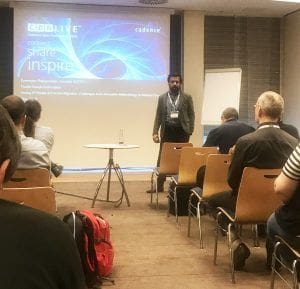
Sowmyan Rajagopalan presenting on schematic porting and analog migration at CDNLive 2018Last month’s CDNLive event in Munich was an important milestone for Thalia. We were able to publicly demonstrate our AMALIA analog migration flow, with particular focus on schematic porting.

The Thalia demo showed an example migration of Bluetooth IP – a circuit containing more than 10 libraries and several tens of schematics – from a 28nm to a 40nm process node. It’s a great example of how human design expertise and analog design automation can combine to speed and ease a migration project. And it’s an approach that can bring real business benefits: our customers are already reporting project timescales shortened, and costs reduced, by up to 50%. In the specific case of 28 to 40nm migration, it’s a move that allows balancing of cost, performance and power consumption, to address multiple market ‘sweet spots’.

I firmly believe that Thalia’s hybrid model is the way ahead for analog design

In my presentation on the final day of the event (Analog IP reuse & process migration: challenges & an innovative methodology to address them), I tried to give a flavor of how we feel Thalia is changing the landscape of analog design. Analog design inherently requires human expertise. But my argument is that, while there is an absolute need for human intelligence and experience, there are aspects of the design flow that could be sped up and improved using a sensible combination of targeted design automation and design experience.

Take analog migration: if you work in the analog world, you’ll know that ‘migration means redesign’ (there’s an excellent article by Ann Steffora Mutschler here on just that topic). That’s a simple home truth: but we shouldn’t therefore assume that there’s no role for design automation in the analog world. What we need to do is create tools and methodologies that support the designer. Because in today’s market, anything we can do to make the process more efficient – and make better use of ‘human capital’ – is hugely valuable.

Our recently-announced partnership with Catena addresses just this problem: we are working with them to completely rethink their approach to analog IP reuse. The aim is to produce a reuse methodology that combines human resources and automation as efficiently as possible, so that Catena can deliver products tailored exactly to customers’ requirements, quickly and at reduced cost. And of course an important part of that is targeting any process technology the customer requires.

I firmly believe that Thalia’s hybrid model – design experience and leveraging automation where it makes sense, and deploying people to do what people do best – is the way ahead for analog design.