Stephane Cordova joins Thalia as Director of Sales Europe

We’re delighted to welcome Stephane Cordova as the newest member of our growing sales team, serving as Director of Sales Europe

Thalia’s Global VP of Sales, Sou Bennani-McCord, says: “As a representative of Thalia, Stephane brings over 30 years of experience as a business executive in the semiconductor industry and brings expertise in EDA solutions, analog and digital SoC from his work with companies like STMicroelectronics, Kalray and Intento Design. His extensive business and sales experience in the semiconductor industry will be a great asset to the team.”

Commenting on his new role, Stephane said: “I am truly honoured to join the team here at Thalia and help the company achieve its business goals for market expansion. Design IP plays a key role in driving innovation in the semiconductor industry. As the complexity and scale of silicon designs increases, Thalia is redefining that landscape, combining the experience of an expert analog design team with a unique development methodology that underpins the AMALIA platform.”

Welcoming our new Global VP of Sales

Thalia has appointed Sou Bennani-McCord as Global VP of Sales. An important addition to Thalia’s leadership team, Sou will play a key role in the company’s ongoing expansion plans and global growth.

Thalia’s Founder and CEO, Sowmyan Rajagopalan, says: “Sou brings over 25 years of experience in international sales and business development to Thalia having worked for both Intel and Mentor Graphics/Siemens. Her experience with sales in both mature and emerging markets, along with her diverse international business background, puts her in an excellent position to support Thalia’s ambitious growth plans and we’re thrilled that she is joining the management team.”

Sou brings a wealth of semiconductor market experience to her role, alongside a strong foundation of strategic business management expertise for technology companies. Sou also holds a Masters in economics and a Post Graduate degree in business management from the Université des Sciences et Technologies de Lille 1, France.

Commenting on her new role, Sou said: “I am excited to join the talented team at Thalia. Thalia’s unique offering and focus on analog and mixed signal IP re-use offers unmatched value to the semiconductor industry. I look forward to taking an active role in Thalia’s growth and expansion plans.”

Thalia expands footprint in China with appointment of Business Partner Fionn Liu

Thalia has appointed Fionn Liu as Business Partner in China following its recently announced expansion plans. Thalia’s Founder and CEO, Sowmyan R., says: “Fionn will play an important role in our business growth as we introduce the AMALIA platform to China. Geopolitical tensions and the forecasted growth in 2024 in China’s semiconductor market have magnified the need for diversification within the supply chain and a robust second sourcing strategy. As a result, semiconductor businesses need to be able to reuse and migrate their IP seamlessly between foundries and this is where our AMALIA platform can help. By leveraging AMALIA’s unique Technology Analyzer and Circuit Porting capabilities, businesses can reduce IP reuse project timelines by a remarkable 40% to quickly ensure their valuable IP can be efficiently deployed across different foundries, regions, or technologies.”

“Fionn Liu brings a wealth of industry experience spanning almost two decades, making her a valuable asset as we expand our footprint in China. Together, we’re ready to assist businesses within this dynamic environment, offering a seamless bridge between IP reuse and second sourcing strategies.”

With almost 20 years of experience in the semiconductor, IIOT and automotive industries, Fionn’s career encompasses both working for established businesses and advising startups in securing business partners, clients and investors. She has extensive experience in building long-term strategy and ecosystem support for high quality companies, and previously worked as a Product Marketing engineer at GlobalFoundries. She holds an MBA, an MS in Advanced Materials for Micro- and Nano-Systems, and a BE in Material Science.

Thalia announces new additions to its senior management team and Board

Thalia, analog IP reuse specialist, has made a number of appointments to its senior management team and Board to drive its recently announced expansion plans. 


Syed Ahmad, VP Product Development

Joining as Vice President of Product Development, Syed Ahmad brings a wealth of experience, having worked with a variety of start-ups and multinational technology companies for over 15 years. Prior to joining Thalia, Syed helped companies to conceptualize, design, plan and manage the delivery of leading-edge communication and collaboration solutions, throughout Europe and USA – bringing an international perspective to all aspects of product management and solutions development. 

Commenting on his appointment, Syed said: “I am working with an excellent and dedicated software development team and looking forward to adding my own mark and supporting team Thalia in the exciting journey to igniting innovation in EDA design automation. More will be revealed as we continue to embark on our path to help our valued customers of semiconductor IPs simplify and drastically reduce time, resources, and costs by leveraging AI & ML algorithms together with some software magic to efficiently speed up IP reuse and deliver design automation.” 


Guillaume d’Essautier, Chairman

Guillaume d’Essautier has assumed the role of Chairman on Thalia’s Board. With a distinguished career spanning four decades within the semiconductor industry, d’Essautier brings an extensive track record of leadership roles in prominent companies across Europe and the USA. 

Thalia’s Founder and CEO, Sowmyan Rajagopalan, says “As Board Chairman, Guillaume will play a leading strategic role in guiding our business through its next exciting stage of growth as we broaden our AMALIA platform and expand our geographical reach. Guillaume is highly-respected within the semiconductor industry and his expertise will be invaluable to the Thalia team and business.”

Most recently Guillaume was CEO of DelfMEMS. Prior to that he was CEO of ADD semiconductor which was acquired by Atmel in 2011. Other businesses that have benefited from his leadership include picoCHIP, Cadence, IBM, Rockwell, GEC-Plessey and Philips. He also holds an MSc in Material Science and an MBA from INSEAD. 


Ron Black, Board Director

Ron Black, CEO of Codasip, a German EDA and RISC-V IP company, has joined Thalia as a Board Director. Ron has over 30 years of industry experience in semiconductors, software, design automation, and IP. He has run a total of ten global technology businesses and been a director or advisor at many more, all of which involved scaling and/or corporate transformations.

Commenting on his appointment, Ron said: “I am excited to join Thalia, which is poised for dynamic growth through its class-leading EDA tools that help customers efficiently scale and optimize their analog/RF designs across process technology nodes.”  

Thalia’s strategic leadership appointments underscore the company’s dedication to pioneering advancements in EDA design automation and transforming the semiconductor IP reuse landscape. 

Thalia announces new CEO and board structure to support continued growth

Cologne, Germany, 4th October 2021 – Following recent announcements on the further development of its AMALIA platform and its application to an expanding range of use cases, Thalia Design Automation, provider of analog and mixed-signal circuit IP reuse platform, today announced the appointment of a new CEO, alongside an extension of its Executive Board.

Founder and former Chief Technology Officer Sowmyan Rajagopalan takes the role of CEO with immediate effect.

The Thalia Board, led by executive chairman Rodger Sykes, has been expanded and an Advisory Board appointed to support and accelerate business growth. Advisory Board members include;

• Kavé Kianush, who has nearly three decades of experience in the industry, working with Philips Research Labs and Philips Semiconductors System Labs, and later as CTO and Vice President of Catena, an IC design-house based in the Netherlands.

• Guillaume d’Eyssautier, who has a career spanning the past 40 years in the semiconductor industry, including management positions in both Europe and the USA. Guillaume is on the board of several start-up companies in the micro-electronics and software domain, and most recently was CEO of DelfMEMS.

Sowmyan Rajagopalan, who founded Thalia in 2011, said that both the re-structure and the addition of an Advisory Board reflect Thalia’s continuing commitment to growth and its determination to further explore new channels and markets for its innovative IP reuse platform.

He commented: “I’m delighted to take on the role of CEO at what is already proving to be an exciting development phase for the business. Across the industry, Thalia is coming to be recognized as truly innovative and disruptive player in the IP reuse market. With the support of a strengthened Board, and our new Advisory Board, we’ve brought further depth and a great deal of fresh experience to the inform commercial strategy and accelerate growth.”

Executive Chairman Rodger Sykes comment: “These structural changes to the business are an indication of its ambition and growing presence in the marketplace. The past several years has been about technical innovation and working hard to meet and exceed the requirements of a growing client list. In the process, we’ve developed an outstanding technology platform and a world-class team of engineers. I am delighted that Sowmyan has agreed to bring his vision, drive and expertise to the role of CEO. I would also like to welcome our new Board members and look forward to working with them to forge the next phase of Thalia’s development.”

CEO Sowmyan Rajagopalan has nearly two decades of experience in the design and development of analog IP, IP strategy, analog EDA solutions and design methodologies. He has been awarded multiple patents in EDA, design and applications. He is responsible for business strategy and leads the company’s development of disruptive EDA solutions, algorithms and methodologies targeting analog migration, design variants and “IP on-demand”.

Thalia’s AMALIA IP re-use platform revolutionizes the reuse of analog and mixed signal integrated circuits – migrating, refining and optimizing existing IP for new applications and technologies. This enables IP houses and IC design companies to re-use and diversify product ranges quickly and cost effectively to meet evolving market demand and reach new markets.

Ends

Funding technology start-ups: stand out for success

Rodger Sykes, Thalia Chairman and CEOHaving just closed our largest funding round to date for Thalia I thought now would be a good time to reflect on the process and the environment.

Like most start-ups, at Thalia we have been through times when things didn’t go to plan. Getting heard and securing customer engagement is always a big challenge in any business.

But the tough times can make you stronger. By listening to customers and refining our offering and business model, we are now seeing strong interest in our analog IP migration and reuse capability. We’ve identified a real business need: and of course that’s one of the keys to convincing any investor to back your company.

In our case, we’ve understood that helping customers move functionality between processes and between foundries is a key capability for cost reduction and security of supply. We can help the trade off all business managers face between deploying valuable internal experienced resource on new IP development or cost reducing existing IP. We turn the latter into a clearly understood and bounded cost and let the internal designers focus on what they enjoy the most – and where they add most value – developing new circuits.

It is a common belief for early stage companies in the tech sector that it’s VERY hard to raise equity funding. In fact in my experience it’s not. Things continue to be very buoyant in the UK given the strong tax incentives available to investors through EIS and SEIS schemes.

There is a great deal of money around looking for a good investment. But “good” is the key word. Good is partly about the strength of the opportunity, but also about how the story is presented. If you have a less than good story and it’s presented badly, then funding is really hard. So if you’re having trouble, don’t blame the VCs.

Far too many founders focus on the technology, as that is their interest and comfort zone. It’s vital to look at the view from the investor’s side of the table. Most investors see hundreds of plans per month; they rarely understand the technology, it’s about return on their investment. VCs are generally not philanthropists. The key is to stand out. A strong exec summary is a key marketing document; that’s vital to get a face-to-face meeting.

Investors look for proof of a large market and customer interest, defensible IP (in case you really have something big), a team that has experience of building a company and so knows what they are doing (founders or advisors), and a financial plan that says you have thought through how much you need to get to break even and where you are going to spend it. Painful as it is for any early stage team, financials are THE common language across EVERY investment, so that’s an area where it’s good to have put in the effort.

It’s a lot to think about, and to do: securing our latest funding round means that Thalia has ticked all of those boxes. It also shows that you should never be afraid to explore new business models or change if you identify an attractive opportunity.

The key above all, however – once you get beyond the first 2-3 rounds of funding to get over the chasm – is customer revenue. Orders and revenue say customers are willing to pay for whatever you have. So as long as there is a global market to scale into, investors will line up.

And if, like Thalia, you have all those bases covered, the venture capital community will welcome you with open arms.

Thalia DA attracts $2m investment to grow analog IP re-use platforms

Will accelerate customer engagement and expansion into USA; further broaden technology development

Thalia Design Automation today announced that it plans significant growth in its worldwide operations, following completion of a $2m (£1.52m) funding round led by Deepbridge Capital and with renewed commitment from the company’s existing investor Development Bank of Wales (formerly Finance Wales).

This latest round of funding will enable accelerated development of Thalia’s Re-use Platform-as-a-Service (RePaaS) solutions for analog IP re-use, design migration and portfolio extension, and aggressive expansion of both commercial and engineering activities in the UK, USA and continental Europe.

“Deepbridge is committed to fostering innovation and growth in businesses with truly disruptive market potential, and we believe that Thalia definitely falls into that category,” said Ray Eugeni, Partner at Deepbridge Capital. “We look forward to helping this globally-focused company fully realize the potential of its unique core technology assets, in markets across the world.”

Commenting on behalf of Thalia, Rodger Sykes, Chairman and CEO, said: “Analog design is one of the toughest challenges in the electronics industry today. I believe Thalia is creating a sea change in this key market, enabling our customers to move to an ‘IP on demand’ model, and offering cost and time schedule savings of up to 50%.”

Dr Carl Griffiths, Fund Manager at the Development Bank of Wales, commented: “Having been involved with Thalia since the early stages of its development, we’re delighted to see the fantastic progress the company has already made in the high value global technology space. Our follow-on investment in this latest funding round demonstrates our strong belief that Thalia has all of the tools to make the most of a massive market opportunity.”

As part of its continuing expansion, Thalia plans to grow its technology development capabilities in the UK and India, as well as establishing a strong presence both in Continental Europe and the USA. The company’s Re-use Platform-as-a-Service (RePaaS) solution combines an innovative methodology, advanced design automation technology and experienced analog engineering resources. It helps analog IP providers to maximize re-use of their existing product portfolio, to create new product variants quickly and easily, and to adapt their designs for manufacture using any semiconductor foundry service.

About Deepbridge Capital
Formed in 2010, Deepbridge was founded with the aim of building an investment team that could redefine the growth capital market. Its purpose is to provide reassurance to investors by enabling them to invest alongside its team of passionate, experienced and fair-minded specialists. A genuine blend of people who know what it’s like to run a business and who have a balanced approach between being good investors, strong managers and practical operators.

Deepbridge believes in supporting, mentoring and investing alongside energetic, high performance management teams. Its ambition is to help businesses achieve their full potential and thereby provide the best possible outcomes for investors.

Deepbridge promotes a culture of professional excellence and integrity: it therefore strongly encourages its investee companies to achieve the highest standards of corporate governance. Deepbridge brings value to investee companies through its proven experience of building growth businesses, involving its network of investors, technology advisors, and industry partners.

https://www.deepbridgecapital.com/

About Development Bank of Wales
The Development Bank of Wales was set up by the Welsh Government to support the economy of Wales by making it easier for businesses to get the finance needed to start up, strengthen and grow. The purpose of the Development Bank is to unlock potential in the economy of Wales by increasing the provision of sustainable, effective finance in the market.

Launched in October 2017, it is a cornerstone organisation for delivery of public sector financial products, supporting micro to medium businesses in Wales and increasing the supply of finance. It promotes economic development through an adaptable delivery model that is responsive to market needs whilst providing continued value for money for public funds. It delivers key Welsh Government policy objectives measured through performance targets and providing investment management and support services across the whole of Welsh Government.

The Development Bank of Wales invested £80m across 420 investments in the financial year 18/19, which in turn attracted £126m in private sector investment.

Media centre: www.developmentbank.wales/media

Thalia-DA unveils AMALIA analog schematic porting capability

Automation accelerates analog design reuse projects by up to 50%

Thalia Design Automation today introduces advanced analog schematic porting capabilities within its AMALIA analog design automation tool suite. Configured for users of TSMC, Global Foundries, UMC, SMIC, and in-house technologies of Tier 1 design companies, the AMALIA schematic porting capability is already proven in analog migration projects to achieve design time savings of up to 50%.

Sowmyan Rajagopalan, Thalia Founder and CTO, commented: “Process migration – moving IP between foundries or process nodes – is one of the biggest challenges facing analog IP providers today, and schematic porting is a key part of that process. The AMALIA schematic porting capability provides all the support an experienced analog designer needs: automating where possible, but also providing analysis and direction to make the task quicker and easier overall.”

Schematic porting is one of the key steps for designers wishing to move analog IP between different foundry providers or process nodes. Integrating with existing AMALIA design centering capabilities, the new tool suggests candidate porting solutions based on key design properties – such as device width/length; technology limitations such as minimum/maximum permissible device dimensions and area constraints; and design constraints.

As well as automating the porting process, the AMALIA Design Suite also significantly increases designer productivity by providing a detailed analysis highlighting issues that require the expertise of an experienced analog design engineer.

The AMALIA porting capability encompasses device mapping, target process rules/ constraints, algorithms for schematic layout and an error checker. It includes algorithms to maintain W/L, transconductance (gm) ratios and total capacitance and resistance values in light of area constraints. It also inspects interconnect and terminal locations, ‘rewiring’ the design to address any shorts.

The schematic porting capability has already played a key role in accelerating migration projects for a number of customers in the RF and power management sector, notably as part of Thalia’s partnership with Catena, a leading provider of radio frequency (RF) communication intellectual property (IP) for connectivity. This partnership, which leverages Thalia’s unique combination of design automation technology and analog expertise, dramatically reduces the time, cost and resources required for Catena to make its IP available in alternative foundry processes. Catena estimates savings of between 40% and 50% for recently completed migration projects.

The AMALIA analog design automation tool suite integrates with the Cadence™ analog design flow, accepting inputs via the industry-standard Component Description Format (CDF). AMALIA schematic porting tools will be commercially available in Q4 2019.

Thalia-DA and Catena confirm successful tape-outs of first analog IP re-use projects

Sub-40nm process migration projects delivered with dramatically reduced project cycle time

Thalia Design Automation and Catena, a leader in radio frequency (RF) communication intellectual property (IP) for connectivity, today announced successful completion of their first jointly delivered analog IP reuse projects. The two companies have worked together to migrate Catena’s WiFi and variants of Bluetooth IP including a low-power version, between multiple sub-40nm process nodes and foundry providers.

Continue reading “Thalia-DA and Catena confirm successful tape-outs of first analog IP re-use projects”

CDNLive: Thalia makes a splash with analog migration solution

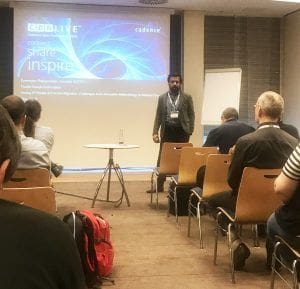
Sowmyan Rajagopalan presenting on schematic porting and analog migration at CDNLive 2018Last month’s CDNLive event in Munich was an important milestone for Thalia. We were able to publicly demonstrate our AMALIA analog migration flow, with particular focus on schematic porting.

The Thalia demo showed an example migration of Bluetooth IP – a circuit containing more than 10 libraries and several tens of schematics – from a 28nm to a 40nm process node. It’s a great example of how human design expertise and analog design automation can combine to speed and ease a migration project. And it’s an approach that can bring real business benefits: our customers are already reporting project timescales shortened, and costs reduced, by up to 50%. In the specific case of 28 to 40nm migration, it’s a move that allows balancing of cost, performance and power consumption, to address multiple market ‘sweet spots’.

I firmly believe that Thalia’s hybrid model is the way ahead for analog design

In my presentation on the final day of the event (Analog IP reuse & process migration: challenges & an innovative methodology to address them), I tried to give a flavor of how we feel Thalia is changing the landscape of analog design. Analog design inherently requires human expertise. But my argument is that, while there is an absolute need for human intelligence and experience, there are aspects of the design flow that could be sped up and improved using a sensible combination of targeted design automation and design experience.

Take analog migration: if you work in the analog world, you’ll know that ‘migration means redesign’ (there’s an excellent article by Ann Steffora Mutschler here on just that topic). That’s a simple home truth: but we shouldn’t therefore assume that there’s no role for design automation in the analog world. What we need to do is create tools and methodologies that support the designer. Because in today’s market, anything we can do to make the process more efficient – and make better use of ‘human capital’ – is hugely valuable.

Our recently-announced partnership with Catena addresses just this problem: we are working with them to completely rethink their approach to analog IP reuse. The aim is to produce a reuse methodology that combines human resources and automation as efficiently as possible, so that Catena can deliver products tailored exactly to customers’ requirements, quickly and at reduced cost. And of course an important part of that is targeting any process technology the customer requires.

I firmly believe that Thalia’s hybrid model – design experience and leveraging automation where it makes sense, and deploying people to do what people do best – is the way ahead for analog design.