The crucial role of second source management and IP reuse in the semiconductor landscape

The global semiconductor industry is witnessing rapid transformation, fuelled by an ever-evolving technological landscape, recent geopolitical tensions and expected growth in 2024. This has magnified the need for diversification within the supply chain and a robust second sourcing strategy. Semiconductor businesses need to be able to reuse and migrate their IP seamlessly between foundries. By harnessing the power of IP reuse through the AMALIA software suite, businesses can achieve supply chain security, mitigate business risks, and improve efficiency and overall reliability. 

Understanding second source management

Second source management is essentially the strategy of partnering with alternative foundries to ensure timely manufacturing and delivery of Silicon IP and IP-based electronics. Given the competitive and unpredictable nature of the semiconductor industry, having an exclusive reliance on a single supplier can lead to potential delays or supply chain challenges. 

Diversifying partnerships through a strategic second source approach allows businesses to spread their dependencies. This not only helps them minimize and mitigate potential risks but also provides a buffer against unforeseen supply chain interruptions, for example queues at foundries for certain technologies and nodes. Moreover, having multiple suppliers in diverse geographical regions can act as an insurance against geopolitical uncertainties, regional foundry availability and unexpected price increases.  

Importance of process node availability

Choosing the right process node is pivotal, defined by its electrical characteristics, the availability of desired devices, and the cost implications of manufacturing. In the subsequent sections, we’ll look at how the AMALIA software suite helps businesses in making informed decisions upfront when considering analog IP migration. 

The benefits of a second source

  1. Risk mitigation: By employing a second sourcing strategy, businesses ensure that product deliveries don’t rely on a single supplier or a supply chain with higher risk profile. This dilution of dependency significantly reduces associated risks.
  2. Supply chain resilience: Second sourcing instills confidence regarding capacity and priority within foundries. Collaborating with a mix of large and smaller foundries offers more flexibility in production, timely deliveries, and the ability to navigate large-scale deals and geopolitical uncertainties

A proactive approach with AMALIA

Being proactive with sourcing begins by identifying critical IP components essential for product functionality and performance. The next steps are: 

  1. Technology Analysis: AMALIA’s Technology Analyzer tool provides a comprehensive comparison of process technologies based on electrical characteristics. This allows for the identification of devices in the target technology that are electrically comparable and more efficient compared to the source IP technology. 
  2. Circuit Porting: AMALIA’s Circuit Porting software translates existing IP design schematics from the source technology and integrates them into the target technology, ensuring that 60-70% of IP blocks meet the required specifications without any design alterations.
  3. Design Verification & Centering: AMALIA’s Design Enabler assists in quickly adjusting circuits to fulfil specific requirements and constraints and helps achieve optimal PPA even if some blocks necessitate design tweaks or architectural changes.
  4. Automated Layout Generation: AMALIA’s Layout Automation tool facilitates the creation of layouts based on existing designs, ensuring accurate device placement and routing while minimizing changes to the existing floor plan and layout

What sets the AMALIA software suite apart is its comprehensive end-to-end nature, covering the entire design flow process and every stage involved. The cumulative speed enhancements at each step leads to significant time and cost savings of at least 40% overall giving businesses an edge in a fiercely competitive market.  

The semiconductor industry’s current trajectory requires businesses to view second sourcing not just as an option, but as a pivotal strategy. Whether it’s about securing product deliveries, reducing supply chain risks, or navigating uncertain geopolitical influences, a well-structured second source management strategy is indispensable. 

Thalia’s AMALIA software suite is revolutionizing this space, offering a time-efficient, cost-effective solution to analysing multiple potential target technology nodes and migrating critical IP from one technology node to another. Whether you’re interested in individual software tools or the entire suite, AMALIA provides both licensing and commercial SaaS-based solutions to cater to diverse business needs. When preferred, Thalia can also help set up and facilitate the use of the AMALIA software directly on a customer’s own servers and data center, ensuring that the IP remains securely within the customer’s controlled environment. 

AI will be increasingly important in EDA, reducing design costs and supporting engineers

Artificial intelligence (AI) is having one of its periodic days in the sun, and dominates the conversation at almost any industry event. The Design Automation Conference (DAC 2023) was no exception, with AI seen by the semiconductor community as both an opportunity and a challenge. 

An opportunity, of course, because AI requires so many chips, from the huge and complex system-on-chips that will power the AI engines and models, to the semiconductors that will be embedded in every device to bring AI to every application.  

The complexity of the chips fuels demand for a wide variety of IP, but this is where some of the challenges are seen. Integrating many blocks of sophisticated IP to form an AI system-on-chip – which may also integrate yet more functionality such as 5G – is a long process, and it requires very advanced skills. There may be hundreds of IP blocks that need to be tested and integrated, with the results recalibrated every time one of the blocks is changed or enhanced. Identifying the cause of a fault or failure may take many engineer-weeks. 

This is true of other chip applications too, of course, including 5G. Engineers with the required skills are in short supply in many markets, and that shortage is worsened by two factors – the number of AI-focused chip start-ups that are now competing for talent, and the increasingly long design cycle for a complex chip, which will consume a growing number of engineer hours before it is ready. 

At DAC, Alberto Sangiovanni Vincentelli, from the University of California at Berkeley, said in a presentation: “The scarce resource of the future is talent. Everyone and his brother wants to study AI. But we don’t have the people to design the chips to implement that AI.” 

DAC buzzed with discussion about how to address the skills gap in electronic design and manufacturing. Some of the ideas were conventional – making electronic engineering more attractive to young people at school and college level, for instance. But of course, another option is to use AI itself, to help or even replace the engineers. 

Some attendees were positive about this development, claiming AI could reduce the time to develop new chips, by taking on some of the tasks of design assistants.  

Of course, others believe such an approach would eventually threaten jobs altogether, especially if the skills shortage eases in future, and the use of AI also entails disruption to tried-and-tested processes and organizational structures. 

But, at least with the current state of AI technology, replacement of engineers is fanciful. Where AI excels is in rapidly gaining actionable insights from huge quantities of data, such as that generated by EDA tools, and that can support the engineers and make their design and verification tasks quicker and less onerous. 

An example is Thalia’s AMALIA software platform. This is an IP re-use platform for analog and mixed-signal ICs, that allows designers to re-use IP blocks quickly and optimise existing IP for new applications. The suite of tools are designed to free up engineers’ time for complex and high-value tasks by automating key processes. The powerful combination of two of the AMALIA tools, the Technology Analyzer and Circuit Porting, which use unique AI algorithms, can be combined typically resulting in up to 70% of IP blocks needing minimal or no changes before they are re-used. This saves a significant amount of engineering time because every block doesn’t need to be manually checked and verified. 

This example shows how AI is already being incorporated into design automation toolsets in order to boost efficiency and improve commercial outcomes. In other words, AI can be a valuable way to support engineers and reduce the time to produce and test complex chips – including those that will, themselves, enable AI processing and applications in future. 

TSMC’s 3nm silicon might not make it into Apple’s iPhone 14 this week, but it’s on its way with some hefty performance benefits

TSMC was last week reported to be starting mass production of 3nm silicon in September, with products based on the node from early 2023

When Intel delayed its orders, it made TSMC think twice about expansion and scaling back capex plans for 2023 but now sounds like things might be getting back on track for 3nm mass production: at least that’s what TSMC is telling investors. A lot rides on Apple deploying the 3nm silicon for its 2023 and 2024 product plans. TSMC’s new nodes usually launched in Spring, so the later launch will have its impacts.

Although Tom’s Hardware states Apple is likely to be TSMC’s first N3 customer, it seems likely that Apple’s iPhone 14 – due to be launched this week – will not contain the latest technology from TSMC.

But the benefits of the migration are clear: N3 versus N5 (5nm) – apart from its more dense logic (1.6X), it offers 10 to 15% improvements in performance and reduced power consumption over 25%. TSMC is already planning its next evolution – not a node change, but a tweak of the 3nm process (N3E).

The benefits of migration are not limited to developments at the bleeding edge. When it detailed plans for 3nm last year, TSMC was also rethinking its highest volume mixed-signal process (28nm – called N28), shifting it to N16FFC (16nm) with significant gains of up to 25%.

As specialists in IP reuse, Thalia helps mixed-signal companies plan for their migration to new nodes or different process technologies. We help to simplify and speed the migration, reducing their time to market and eliminating costly interruptions in the supply of their most important product lines.

Chip shortages, chip surpluses, or is it just a question of strategic choices…?

It’s been three months since our last blog on chip shortages, and a lot has changed in that time, so it’s worth an update and sharing some thoughts on what are the ramifications that may or may not be affecting our industry’s ability to plan in the mid- to long-term. 

Peter Clarke, a long-standing well-informed observer of semiconductor industry trends, reported earlier this month on eeNewsEurope that industry growth is slowing https://www.eenewsanalog.com/en/fall-in-global-chip-market-growth-accelerates/ – we’re still talking about 13 percent growth – it’s just less growth. 

Some volatility clearly remains in the market, but the companies with the ‘right’ focus on emerging and fast growth markets are benefiting. The latest set of results from mixed-signal IC leader OnSemi were particularly healthy. It will always be the case that changing market conditions and industry shifts in terms of technologies and applications, benefit those companies that can adapt and evolve and those that simply back the right horse. 

It is also worth mentioning, as we tackled this in the previous post, the world was facing a huge supply issue post-covid and entering periods of significant demand hikes from the automotive and consumer electronics industries, in particular.  

The response to this supply issue was for the well-funded chip manufacturing giants to ramp up and speed up their development plans – and at the same time to further their globalisation plans, thus addressing geopolitical question marks. TSMC’s fabs in the US, Intel investing in Germany – are some of the moves we have seen so far. Europe’s own appetite for a bigger piece of the semiconductor pie has only been fuelled by the slowdown and capacity crunch. 

Gartner also announced recently it is expecting a small drop in chip sales in 2023, following a slowing in mobile phone sales (such a forecasted drop of around 150million, can easily create waves in the semiconductor supply chain in its own right). This is made worse by a predicted 9% drop in personal computer sales by the end of 2022. 

Given the mobile handset’s significant size and global scale, a drop in sales is likely to contribute to an easing of the chip shortage issue – probably later this year or early in 2023 – but, combined with the industry’s drive to increase its manufacturing output, could it create oversupply issues?  

Well, questions are being asked if the US Chips Act is poorly timed, when the industry is potentially facing a slowdown and oversupply issues. But a committed, long-term investment to attract or retain chip manufacturing is unlikely to be a poor strategic choice, in my opinion. 

Time will tell, but as demonstrated by OnSemi, a bit of longer-term planning and strategic marketing in terms of the growth markets, can go a long way to alleviate temporary blips in shortages and oversupply.  

If your strategy includes IP-reuse, to maximise Return on Investment, then talk to our team at Thalia. Or read more about the AMALIA IP reuse platform. 

Exploring IP Reuse opportunities in 2022 at Siemens EDA User2User Europe event

The Siemens U2U event takes place in the US (Santa Clara, CA), and here in Munich, Germany. We couldn’t resist the opportunity to be part of an event on our doorstep where we could learn, share and network with fellow technical experts who design leading-edge products using Siemens EDA tools.

In particular, the well-attended and in-depth user-focused event turned out to be a fantastic opportunity for the Thalia team to really get ‘under the hood’, to understand how things work with the entire Siemens EDA flow and, in particular, how to integrate the Tanner EDA and AFS Simulator into Thalia’s AMALIA solution.

Siemens EDA, then Mentor Graphics, acquired Tanner EDA back in 2015 and the powerful analog-mixed signal tools are now thoroughly integrated as part of the Siemens EDA toolflow. Some of Thalia’s customers utilize the AFS (Analog Fast SPICE) Simulator so in-depth discussions with Siemens engineers and some of the Tanner EDA specialists enabled us to really do some deep-dive discussions which will educate our own customer engagements.

The event also gave the team an opportunity to directly engage with some of our potential customers, to explore how IP reuse using the Thalia AMALIA platform, could help their migration strategies and help them to both accelerate time to market and drive down costs of porting to more cost-effective nodes or manufacturing options.

It was interesting to see what Tanner EDA team presented on an XFAB case study, demonstrating how easy the Tanner custom IC design tools from Siemens are to use and to integrate with best-in-class circuit simulators, Calibre for design rule checking, parasitic extraction and physical verification.

In terms of what opportunities lie ahead for AMALIA and our IP reuse platform, it was really interesting listening to Joe Sawicki, EVP at Siemens EDA in his session ‘From IC to Systems: New Opportunities for the Semiconductor Industries’ which focused on supporting technology scaling which is driven by increasing system complexity and migrating to new nodes but with it comes an escalating cost to create new SoCs of unprecedented size and functionality on accelerated schedules.

Future Horizons CEO Malcolm Penn pondered how the semiconductor industry will continue to perform and how it can be accurately forecast in the face of the death of Moore’s Law.

Overall, an excellent event, and a great deal of knowledge and insight taken away for our own thinking. With thanks to Siemens for putting on this conference. 

Ramifications for planning in the face of chip shortages

This is the third and final blog in a short series of posts looking at the chip shortage crisis our industry is facing. Previous posts looked at the political situations both affecting and attempting to tackle the problems, and how the chip makers are ramping up and investing in their own attempts to sensibly fill the supply gaps and maximize on the opportunities as quickly as possible. 

In a previous recent blog, I’ve set out some thoughts on the realities and impacts of chip shortages on the evolving connected car market.  

S&P are scaling back forecasts on car production for 2022, given the chip supply issue affecting the industry. Automotive industry impact: ‘Toyota and Nissan, have scaled back production and others such as BMW, Ford and Volvo have removed certain features from some cars to enable them to continue production.’ 

In the mobile phone markets, Samsung and Apple have been using their might to maintain their own supplies…but other OEMs have been left struggling
“low-end OEMs…struggled the most to adapt with chip foundries expected to take “years” to spool up to demand.” https://www.androidpolice.com/apple-and-samsungs-smartphone-businesses-are-surviving-the-global-chip-shortage-in-ways-only-they-can/ 

In the face of chip shortages and times of geopolitical uncertainty, shortages will continue in the short to mid-term at least, so OEMs looking to remain competitive will need to continually assess their options and consider moving or duplicating (second-sourcing) designs to secure capacity from more than one manufacturing partner. 

Some Tier 2 fabs are positioned ready to seize the opportunities in these times of uncertainty – they can offer attractive costs and potentially be more responsive and adaptable to customer needs. 

Migrating IP to other fabs, design nodes or process technologies can be complex and, itself, time-consuming (hence competitively prohibitive) unless it’s done with the right tools. That is where we at Thalia can help. For 2022 and possibly into next year we need to help our customers reduce their costs in IP migration through innovative IP reuse, and help to maintain their competitive edge. 

Diversification and investments

The second in our series of blogs looking at pressures on the industry of the chip shortage discusses what we see happening in the chip manufacturing (wafer fabs) industry, in particular. This is an industry traditionally dominated by a small number of players and the price of entry is huge – hence, a bit like turning a container ship, these giants take time to move and the costs of expansion are significant. 

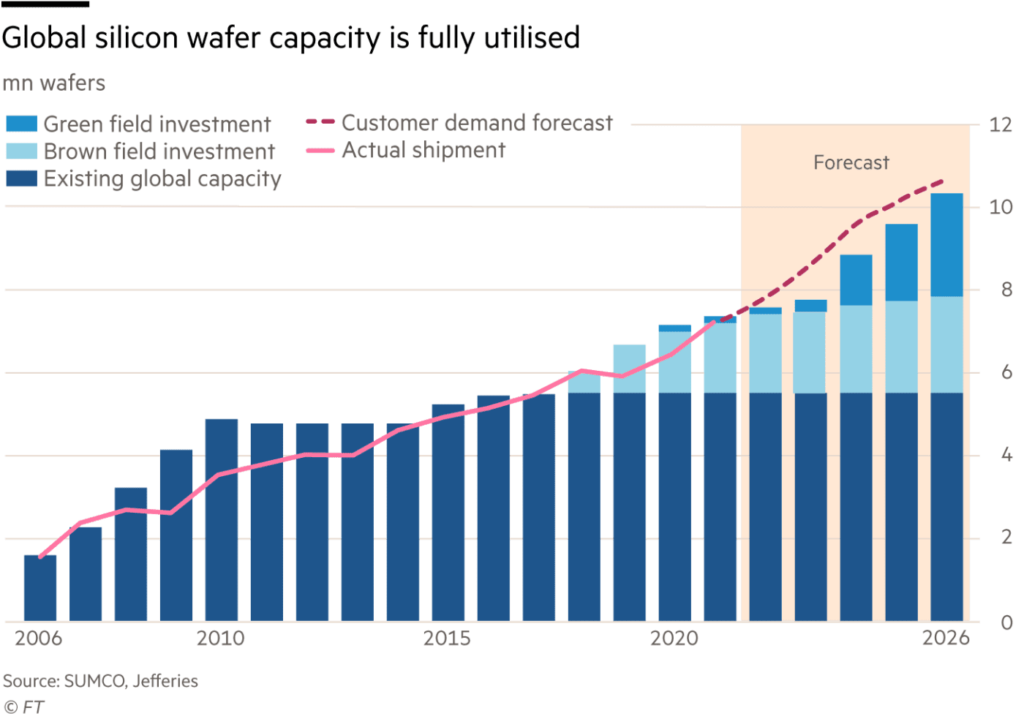
At advanced process nodes (used for mobile devices such as advanced smartphones, tablets), TSMC is responsible for an estimated 92% of global production. Across the board, TSMC still supplies a quarter of the world’s supply of chips (24%) – and its capacity is fully utilised and it continues to expand its facilities: particularly important that this expansion is happening overseas given the geopolitical risks mentioned in the previous blog.  

TSMC is being bullish and believes the demand is a long term upward trend and is even committing $100Bn in investments to expand its own capacity and research facilities.  

But it’s clear that given the geopolitical risk we discussed in the previous blog, TSMC sees the need for its future facilities to be more globally diversified. The technology industry is nervous about the impact on the #1 supplier with tensions once again growing between China and Taiwan. One active TSMC strategy is building the fab in Phoenix, Arizona:  

https://www.cnbc.com/2021/10/16/tsmc-taiwanese-chipmaker-ramping-production-to-end-chip-shortage.html 

The final blog in the short series on ‘chip shortages’ will look at the impact on planning decisions and the measures companies need to take to maintain profitability in the face of time-to-market pressures and a shift in the chip supply chain. 

Geopolitics and global chip shortages

This blog is the first in a series of three snapshot articles on the effects of chip shortage on the industry: What impacts is it having? What changes are taking place in the industry, or even in politics, in attempts to guarantee supplies and ring-fence national or regional supplies? And finally, once plans are in place for second-sourcing, or alternative manufacturing, how does that affect design decisions, time-to-market and ultimately, profitability? 

Access to chip supplies – hence to the manufacturing of chips – have become a strategic initiative for companies and nations alike. Lockdowns due to Covid-19 has arguably caused a lot of the ‘tailbacks’ seen in the industry. But while it’s been a catalyst, there are other factors at play and it’s making nation-states and regions start to evaluate the strategic importance of their chip supplies. 

The fact is, in spite of problems with supply chain, or businesses affected in various ways due to Covid-19 lockdowns, demand has not dropped off, and shows no signs of scaling back. Quite the opposite. 

In fact, we’ve seen in recent weeks, the risks of global conflict certainly affect supply and demand and can impact the industry in ways we’d never thought of, with the growing crisis in Ukraine set to affect the supply of palladium and scandium – some of the raw materials used in chip manufacturing:  

But more generally, changes in the geopolitical climate are making chip companies consider and reconsider where they source or where they manufacture. US politics can discourage or stop companies from moving their manufacturing to China for example.  

Global Wafers attempting to invest in Siltronic – but ‘stalling’ for what appears to be political reasons. 

The big wafer fabs are rethinking their own strategies to both keep pace with the chip shortage and to fend off geopolitical risks that may affect their own supplies or access to their customers. Some of this is the Tier 1 chip makers extending their manufacturing, both to other parts of the world, or in the same region to simply increase their capacity. 

But it’s not a quick fix: wafer fabs take a lot of money and typically at least three years to build and become operational. 

In Europe, the $43bn EU chips act is targeting European self-sufficiency to raise its game – aiming for 20 percent of the global market by 2030. The act also is also designed to prioritise Europe’s own needs ‘in times of shortages’. 

The second blog in this series will look at how companies are restructuring and where investment decisions are being driven by the risks of global chip shortages and these geopolitics pressures.

Connected car: The growing demands of automotive OEMs and the supply chain

In a recent post on EDA Cafe I talked about industry trends, and highlighted how automotive chip usage has traditionally been small by comparison to consumer electronics – but its market is growing.

As a subset of the car market, connected and autonomous vehicles (CAVs) is a market set to grow exponentially in the next five years. In figures from Allied Market Research, the global connected car market was valued at $63.03 billion in 2019, and is projected to reach $225.16 billion by 2027.

The use of other, traditional in-vehicle system, control and multimedia electronics continue to grow.

But there are both opportunities and threats within connected car.

The number of sensors even in traditional vehicles is growing significantly – from an average of 100 today, to at least doubling for a connected car. Connected cars obviously have a certain volume of sensors, wireless communications, and interface devices for driver, passenger or for maintenance. Move into autonomous, and clearly the need for sensors grows rapidly as does the need for more secure and functionally-safe systems.

These opportunities need to be balanced in the face of the (now very real) global semiconductor shortage. System designers will have to tackle capacity issues at foundries and component shortages at their usual semiconductor OEMs. Manufacturing capacity issues are here today and for the foreseeable future.

In October 2021, Tom Caulfield, CEO of GlobalFoundries was quoted as saying that they have sold all capacity until 2023. TSMC and other fabs are rapidly looking for ways to expand their production – but building new cutting-edge wafer fabs takes time (years, not months).

It’s clear the industry is painfully aware of this capacity crunch and ongoing threats to their supplies. Jaguar Land Rover recently pointed to chip shortages for its £9 million loss in the last three months of 2021. Retaining flexibility in design, choice of manufacturing and agility in working with different mixes of components will be crucially important to the automotive industry in the next 24 months.

Sources below:

https://www.ft.com/content/03377749-1fcb-4504-9959-8ebd7f581b2e